

By Kellie Thimmes, BS, CIC, DISIPC
Director of Education, ProEdge Dental Compliance Labs
Waterline testing may feel redundant, especially if your practice already uses a treatment product. But treating your dental unit waterlines alone is not enough to prove compliance.
Why? Because even treated waterlines can fail.
Treatment products lose effectiveness. Biofilm persists. Equipment malfunctions. Protocols slip. Without testing, you have no way of knowing whether your treatment is actually working; you’re only hoping it is.
In fact, in “Treating and Monitoring Dental Water” by Nancy Dewhirst, RDH, BS and John A. Molinari, PhD, they share that:

The CDC recommends that water used during routine dental treatment contain no more than 500 colony-forming units per milliliter (CFU/mL) of heterotrophic water bacteria, and that practices routinely monitor water quality to confirm treatment protocols are working.¹
Without a proper testing protocol in place, you will never know whether or not your treatment is effective. The truth is that in the world of dental unit waterline (DUWL) maintenance, what you don’t know certainly can hurt you, your practice, and your patients.
Treatment is what you do. Testing is how you prove it worked.
The Impact of Contaminated Dental Water
Contaminated dental water isn’t just a documentation gap. It’s a patient safety crisis waiting to happen.
In 2022, the CDC issued a Health Alert Network advisory after suspected nontuberculous mycobacteria (NTM) infections surfaced among children who had undergone dental procedures. Preliminary testing at the clinic found microbial counts far above the CDC-recommended level.²
The advisory also revisited two earlier outbreaks that should serve as a warning to every practice: in 2016, 71 patients in Orange County, California, developed odontogenic NTM infections following pulpotomy procedures. In 2015, 24 children in Georgia developed Mycobacterium abscessus infections after similar treatment.³
In both cases, the practices were not regularly monitoring their dental water quality as the CDC recommends.
And this risk isn’t confined to pediatric pulpotomies. Dental unit water is used every single day: in hygiene appointments, restorative care, and routine treatment across every operatory.
A treatment product sitting in a bottle, or installed on a dental unit, does not prove your water is safe. A documented test result does.
Using Knowledge as Prevention
The good news is that understanding your waterline quality and subsequently addressing it doesn’t have to be time-consuming, complicated, or expensive.
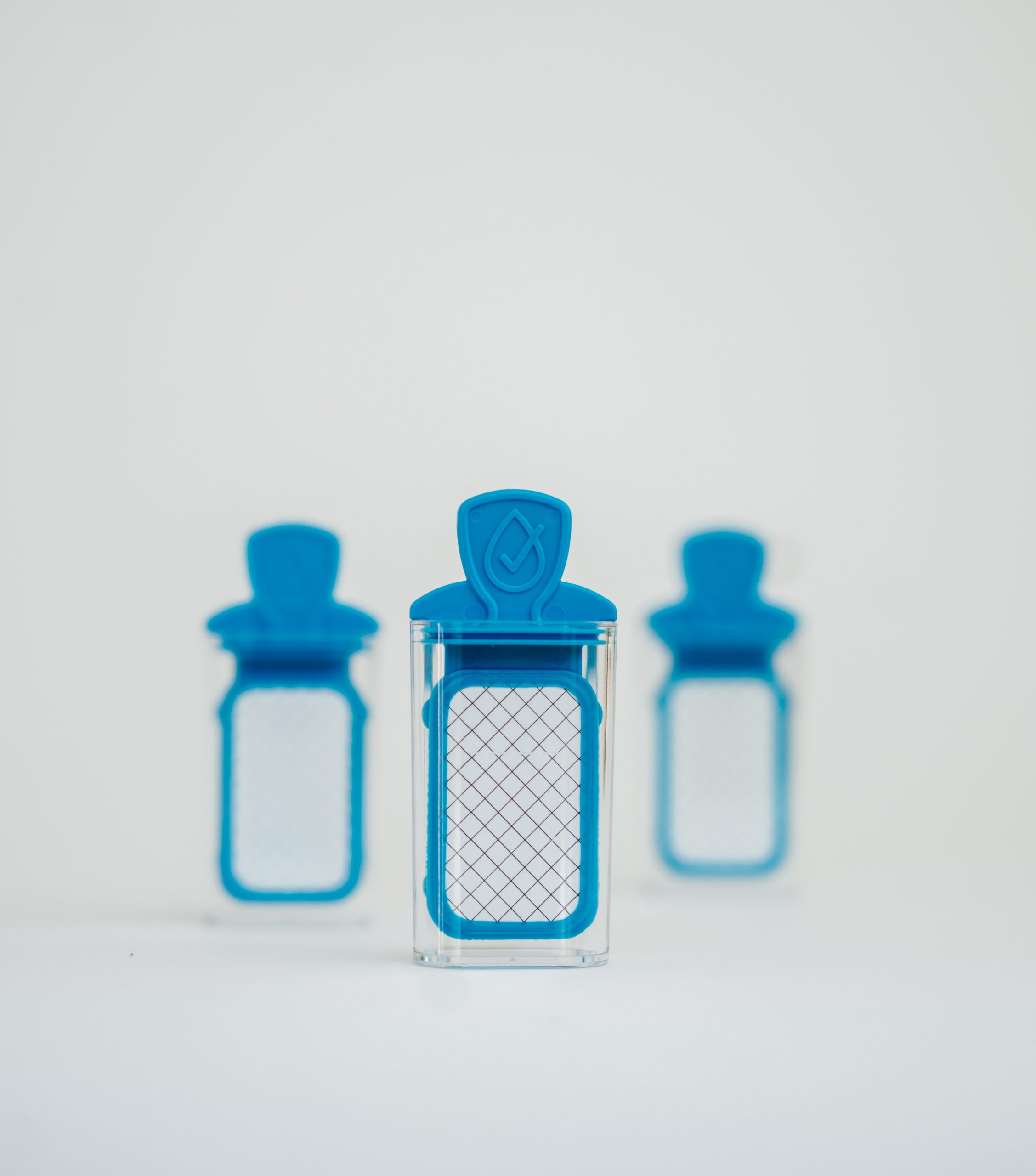
Enter QuickPass®, the industry’s #1 most trusted and best-selling in-office dental water test. Recognized with the Cellerant Best of Class Hygiene Award for three consecutive years, QuickPass was designed specifically for dentistry to provide much more than a basic screening result.
Let’s be clear: QuickPass is not a pass/fail screening tool. It is a quantitative heterotrophic plate count test that provides a measurable CFU/mL result, not simply a yes or no.
That distinction matters. The CDC’s standard is quantitative (≤500 CFU/mL), so a test that provides a measurable CFU result offers greater clarity when determining and documenting whether your water meets the standard. It can also reveal when bacterial levels are beginning to rise, allowing your team to adjust its protocol or remediate the waterlines before a near-fail becomes a failure.
QuickPass does exactly that.
Unlike screening tests that merely flag whether bacteria might be present, QuickPass lets your team quantify the bacterial concentration in a sample. Its CFU/mL ranges show whether your water is safely below the CDC threshold, approaching it, or exceeding it, with no ambiguity.
QuickPass isn’t a preliminary check to run between “real” water tests. QuickPass is the test.
Because it delivers a quantitative CFU/mL result, QuickPass can serve as your practice’s documented quarterly waterline test.
- QuickPass also offers:
- Built-in neutralization for more accurate results
- Easy-to-see colonies for simpler reading
- About five minutes of hands-on time per operatory
- Private, in-office results in 48–72 hours
- Unlimited access to ProEdge Safe Water Experts
- Complimentary access to the ProEdge Clear™ Compliance Dashboard to document results, track testing history, and stay organized
Treat It, Then Prove It
Testing tells you where your water stands. Treatment is how you keep it there. ProEdge offers two treatment options, so you can choose whichever fits your practice’s workflow best:
- BluTube® – A low-maintenance cartridge system that treats continuously for up to a year, with just one swap every six months.
- BluTab® – Daily effervescing tablets for practices that prefer a hands-on, bottle-by-bottle routine.
BluTube and BluTab are two paths to the same goal, so choose one rather than combining them. Paired with QuickPass, either option gives you a complete protocol: consistent treatment, backed by quantifiable proof.
Turn Your Results Into Action
Some practices hesitate to test because they’re afraid of what they might find. But an unknown failure doesn’t protect your patients or your practice. It only delays your chance to fix it.
A failed test isn’t bad news. It’s actionable information. It allows your team to investigate the cause, remediate the affected lines, and retest to confirm that the corrective action worked.
With QuickPass, your team never has to guess whether its treatment protocol is working. You can quantify the bacterial level, compare it with the ≤500 CFU/mL standard, and document the results with confidence.
Using a treatment product is only part of the process. QuickPass closes the loop by showing you whether your protocol is actually working and giving you the documentation to prove it.
No guessing. No settling for a simple pass or fail. Just clear, quantitative results that help protect your patients, your practice, and your peace of mind.
1“Treating and Monitoring Dental Water” by Nancy Dewhirst, RDH, BS and John A. Molinari, PhD
2 Centers for Disease Control and Prevention: Outbreaks of Nontuberculous Mycobacteria Infections Highlight Importance of Maintaining and Monitoring Dental Waterlines
3 CDC: Notes from the Field: Mycobacterium abscessus Infections Among Patients of a Pediatric Dentistry Practice, Georgia, 2015

You must be logged in to post a comment.